
What is a child’s favourite question? WHY?! And why is that?
Because our brains are meaning-making machines programmed with a series of “whys”—sometimes called ‘frames’. When the why is answered, our brains store that information and use it to make sense of future situations, people, and places.
But what happens when we don’t have all the information?
We fill the gaps.
An assumption is simply a meaning, or ‘frame’, we attach when facts are missing. It’s natural — our brains do it to work efficiently, saving time and energy.
The problem? It’s not always accurate.
The Danger of Assumptions Under Pressure
Think about the last time something went wrong for you at work or home. Maybe someone did not meet an expectation, broke something, or got hurt.
What assumption did your brain jump to?
Was it positive… or negative?
For our brains, close enough is often good enough – and assumptions usually help us function through everyday life without overthinking. But in high-stress, high-pressure, high-stakes situations, those same assumptions, combined with cognitive biases, can set a trap.
Cue the old saying: “When you assume, you make an ASS out of U and ME.”
The Two Biggest Biases That Distort Our Thinking
The most common biases that can guide our brains to make negative assumptions about people or situations are:
- Negativity Bias: The brain’s tendency to give more attention and weight to negative experiences or information than to positive ones.
- Fundamental Attribution Error: The tendency to over-attribute other people’s actions to their character (“They’re careless!”) rather than external circumstances (“Maybe they’re under pressure.”).
Left unchecked, these biases can lead to:
- Blame and criticism.
- Harsh communication and misunderstandings.
- Lower empathy and patience.
- Focus on defensiveness instead of learning or solving problems.
The bigger result?
- Small issues become big ones.
- People feel attacked, not understood.
- Blame culture takes over, reducing collaboration and growth.
- Mistakes get hidden instead of surfaced and fixed.
The Fix? Flip Your Assumptions
When things go wrong, instead of rushing to judgment, use positive assumptions — paired with powerful questions — to understand the true “why” of a situation or a person’s behaviour.
What is a positive assumption?
A positive assumption is a conscious choice, or ‘frame’, we can make to interpret someone’s actions, words or intentions in a constructive or generous way, rather than assuming the worst. It’s about giving others the benefit of the doubt, especially when there’s ambiguity.
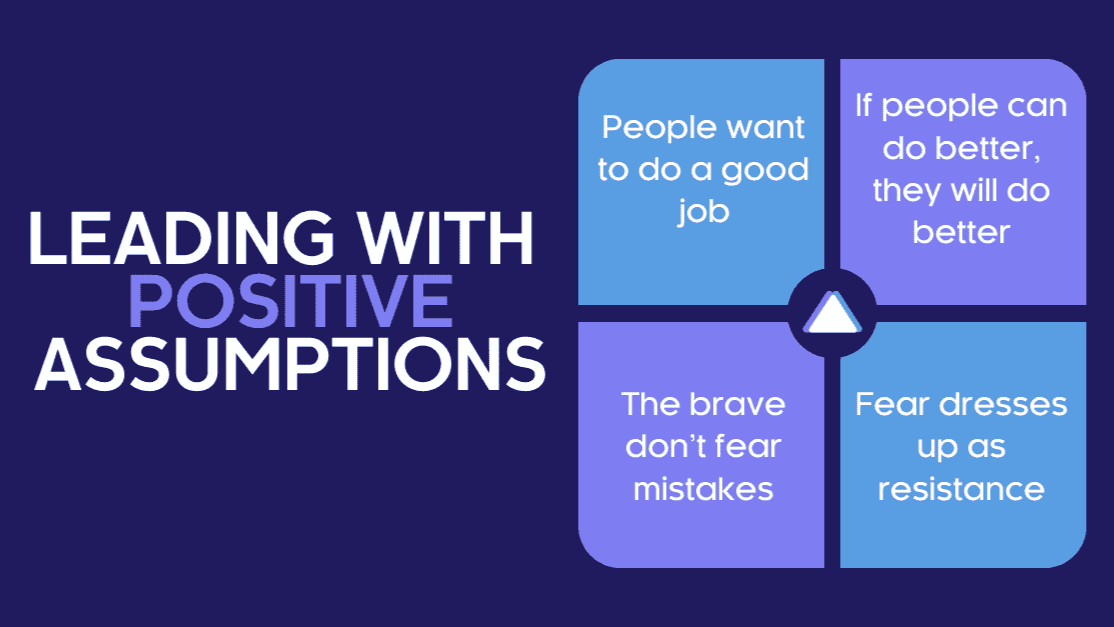
Here are 4 Positive Assumptions to guide you:
1. People want to do a good job.
Ask yourself: “We don’t have all the information — is more going on here that we can’t see yet?”
2. If people can do better, they will do better.
Ask yourself: “What more could we have done to set this project (or person) up for success?”
3. The brave don’t fear mistakes — they mine them for gold.
Ask yourself: “What can we learn from this to improve for the future?”
4. Fear dresses up as resistance.
Ask yourself: “What fear might be hiding underneath this resistance?”
Leading with Positive Assumptions
In the Tenaxiti Business Psychology ADAPT Leaders program, we focus on the importance of situational leadership and provide tools to be more thoughtful, deliberate and adaptive in how we ‘frame’ and approach challenges, mistakes and uncertainty.
Leading with positive assumptions isn’t about ignoring problems. It’s about choosing curiosity over judgment and building an environment where people can solve, grow, and succeed — even when things go wrong.
What about you?
What positive assumptions have helped you turn a high-stress or high-pressure situation into a learning opportunity?
Keen to learn more?
I work with senior leaders and executive teams to drive cultural alignment, strengthen safety and leadership, and navigate complexity with clarity. Feel free to connect here or reach out directly via www.tenaxiti.com.au — happy to have a conversation.